Heat Exchanger
2017-05-02
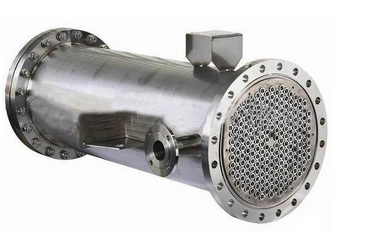
Tubular heat exchanger is currently the most widely used chemical and alcohol production of a heat exchanger. It is mainly composed of shell, tube plate, heat transfer tube, head, baffle and other components. The required material can be made of ordinary carbon steel, copper, or stainless steel, respectively.
species
Fixed tube plate type
Tubular heat exchanger structure is relatively simple, compact, cheap, but the tube can not be mechanical cleaning. The heat exchanger tube bundle is connected to the tube plate, and the tube plate is welded at both ends of the shell, and the top cover and the shell are connected with fluid inlet and outlet. A series of baffles that are perpendicular to the tube bundle are usually provided outside the tube. At the same time the pipe and the tube plate and the shell connection are rigid, and the tube tube is two different temperature fluid. Therefore, when the temperature difference between the wall and the shell wall is large, due to the different thermal expansion of the two, resulting in a large temperature stress, as well as the tube twist or pipe from the tube board loose, or even destroy the heat exchanger.
In order to overcome the temperature stress must have a temperature compensation device, generally in the wall and the wall temperature difference of 50 ℃ or more, for safety reasons, the heat exchanger should be temperature compensation device. But the compensation device (expansion joint) can only be used in the shell wall and wall temperature difference of less than 60 ~ 70 ℃ and shell fluid pressure is not high case. General shell pressure exceeds 0.6Mpa when the compensation circle is too thick, difficult to stretch, loss of temperature compensation role, you should consider other structures.
Floating head style
A tube plate of a heat exchanger is connected to the housing by a flange and the other tube plate is not connected to the housing so that the tube can be freely retracted when heated or cooled, but a roof is attached to the tube sheet, Floating head ", so this heat exchanger is called floating head heat exchanger. The advantages are that the tube bundle can be pulled out for cleaning; the expansion of the tube bundle is constant, so that when the temperature difference between the two heat exchanger media is large, the temperature difference between the tube and the shell is not different The The shortcomings of the complex structure, high cost.
Stuffing function
This type of heat exchanger tube bundle can be free to expand at one end, the structure is simpler than the floating head, the cost is lower than the floating head. However, there may be leakage of shell media, shell should not deal with volatile, flammable, explosive and toxic media.
U-tube type
U-tube heat exchanger, each tube are bent into a U-shaped, both ends fixed on the same tube board, each tube can be free to expand, so as to solve the problem of thermal compensation. The pipe is at least two, the tube bundle can be cleaned, the tube can be free to expand. The drawback is the difficulty of cleaning the inner wall of the pipe, the tube is difficult to replace, and the tubes on the tubesheet are less. The advantage is simple structure, light weight, suitable for high temperature and high pressure conditions.
Eddy current hot film
The vortex heat film heat exchanger uses the latest vortex heat film heat transfer technology to increase the heat transfer effect by changing the fluid motion state. When the medium passes through the surface of the vortex tube, the surface of the pipe is strongly washed to improve the heat transfer efficiency. Up to 10000W / m2 ℃. At the same time this structure to achieve a corrosion-resistant, high temperature, high pressure, anti-fouling function. Other types of heat exchanger fluid channel for the fixed direction of the flow form, the formation of heat transfer tube surface flow, convective heat transfer coefficient decreases.
According to the [heat exchanger equipment promotion center] data show that the biggest feature of eddy current hot film heat exchanger is the unity of economy and safety. Considering the flow relationship between the heat transfer tubes, the heat transfer tubes and the shells, the turbulence is no longer forced by the baffles, but the alternating vortices are naturally induced by the heat transfer tubes. In order to ensure that the heat transfer tube does not friction with each other under the premise of maintaining the required vibration. Heat transfer tube rigid and flexible configuration is good, not collision with each other, not only to overcome the floating coil heat exchanger collision between the damage caused by the problem, but also to avoid the ordinary shell and tube heat exchanger easy to fouling problems.
Eddy current hot film heat exchanger performance characteristics:
1. Energy efficient, the heat transfer coefficient of 6000-8000W / m2.0C;
2. All stainless steel production, long life, up to 20 years, within ten years of heat exchanger quality problems free replacement;
3. The laminar flow is turbulence, which improves the heat transfer efficiency and reduces the thermal resistance.
4. Heat transfer speed, high temperature (400 ℃), high pressure (2.5Mpa);
5. Compact structure, small footprint, light weight, easy installation, saving civil construction investment;
6. Design flexibility, complete specifications, practical targeted, saving money;
7. Wide range of applications, for greater pressure, temperature range and a variety of media heat exchange;
8. Maintenance costs are low, easy to operate, cleaning cycle is long, easy to clean.
9. Using nano-film technology, significantly increase the heat transfer coefficient.
10. Wide range of applications, can be widely used in thermoelectric, factories and mines, petrochemical, urban central heating, food and medicine, energy electronics, machinery, light industry and other fields.
Eddy current hot film heat exchanger performance comparison:
|
Contrast project |
Floating coil heat exchanger |
Threaded pipe heat exchanger |
Eddy heat film heat exchanger |
|
Applicable media type |
Steam, water |
Steam, water |
Weak corrosive chemical raw materials, steam, water |
|
The range of parameters for the media |
Temperature: 0-150 degrees
|
Temperature: 0-150 degrees
|
Temperature: -40-400 degrees
|
|
Thermal efficiency |
Thermal efficiency = 92% |
Thermal efficiency = 93% |
Thermal efficiency = 96% |
|
Anti - scaling performance |
Automatic descaling |
Artificial descaling |
With anti-scaling function |
|
Seismic, noise |
Vibration, noise |
Vibration is small, the noise is small |
Vibration is weak, the noise is small |
|
Trial life |
7 years or so |
10 years or so |
20 years or so |
|
service |
Stop maintenance, replacement tube bundle |
Downtime maintenance, extubation and then expansion tube |
No maintenance required |
Baffle baffle
In order to improve the shell-side fluid flow rate, often in the shell to install a certain number and tube bundle perpendicular to the baffle. The baffle not only prevents the fluid from short-circuiting, increases the fluid flow rate, but also forces the fluid to pass through the tube bundle multiple times according to the specified path, causing the turbulence to increase greatly. Commonly used baffle with round shape and disc shape two, the former is more commonly used.
Multi - shell
Tubular heat exchangers must be considered from the structural effects of thermal expansion, take a variety of compensation methods to eliminate or reduce thermal stress, according to the temperature compensation measures taken.
3 technical parameters
|
Nominal diameter |
Number of pipes |
The number of pipes |
Heat transfer area nominal value / calculated value |
Pipeline cross-sectional area Flow rate m / hr at flow rate of 0.5 m / sec |
Nominal pressure |
|
|
|
|
|
Pipe length (m) |
φ25×2.5 |
|
|
|
|
|
|
|
|
|
1500 |
2000 |
3000 |
4000 |
6000 |
φ25×2 |
|
|
|
|
|
159 |
1 |
14 |
1.51.62 |
22.17 |
33.27 |
|
|
0.0044/ 0.0049 |
7.92/ 8.82 |
|
219 |
1 |
26 |
3/3.00 |
4/4.02 |
6/6.06 |
8/8.1 |
|
0.0082/ 0.0090 |
14.76/ 16.20 |
|
|
2 |
26 |
3/3.00 |
4/4.02 |
6/6.06 |
8/8.81 |
|
0.0041/ 0.0045 |
7.38/ 8.01 |
|
273 |
1 |
44 |
5/5.08 |
7/5.18 |
10/10.26 |
14/13.72 |
21/20.63 |
0.0138/ 0.0152 |
24.84/ 27.36 |
|
|
2 |
40 |
5/4.62 |
6/6.19 |
9/9.33 |
12/12.47 |
19/18.76 |
0.0063/ 0.0069 |
11.24/ 12.42 |
|
325 |
1 |
60 |
7/6.93 |
9/9.28 |
14/14.00 |
19/18.71 |
28/28.13 |
0.0188/ 0.0208 |
33.84/ 37.44 |
|
|
2 |
56 |
6/6.47 |
9/8.66 |
13/13.05 |
17/17.46 |
36/26.26 |
0.0088/ 0.0097 |
15.84/ 17.46 |
|
400 |
1 |
119 |
14/13.47 |
18/18.41 |
28/27.76 |
37/37.10 |
55/55.8 |
0.0374/ 0.0412 |
67.32/ 74.16 |
|
|
2 |
110 |
13/12.70 |
17/17.02 |
26/25.66 |
34/34.20 |
50/51.58 |
0.0173/ 0.0190 |
31.14/ 34.20 |
|
500 |
1 |
185 |
|
|
45/4.15 |
55/57.68 |
85/86.74 |
0.0581/ 0.0641 |
104.58/ 115.38 |
|
|
2 |
180 |
|
|
40/41.99 |
55/57.68 |
85/86.74 |
0.0283/ 0.0312 |
50.94/ 56.16 |
|
600 |
1 |
269 |
|
|
60/62.7 |
85/83.88 |
125/126.13 |
0.0845/ 0.0932 |
152.10/ 167.76 |
|
|
2 |
266 |
|
|
60/32.05 |
80/82.94 |
125/14.72 |
0.0418/ 0.0461 |
75.24/ 83.98 |
|
700 |
1 |
379 |
|
|
90/88.41 |
120/118.17 |
175/177.71 |
0.0091/ 0.1313 |
214.38/ 236.34 |
|
|
2 |
358 |
|
|
85/83.51 |
110/111.62 |
165/167.85 |
0.0562/ 0.0620 |
101.16/ 111.60 |
|
800 |
1 |
511 |
|
|
120/119.20 |
160/159.16 |
240/239.60 |
0.1605/ 0.1770 |
288.90/ 318.60 |
|
|
2 |
488 |
|
|
115/113.83 |
150/152.16 |
230/228.81 |
0.0767/ 0.0845 |
138.06/ 152.10 |
|
900 |
1 |
649 |
|
|
150/151.39 |
200/202.36 |
305/304.3 |
0.2039/ 0.2248 |
367.02/ 404.46 |
|
|
2 |
630 |
|
|
145/146.96 |
195/196.44 |
295/295.40 |
0.0990/ 0.1091 |
178.20/ 196.38 |
|
1000 |
1 |
805 |
|
|
185/187.78 |
250/251.00 |
375/377.45 |
0.2529/ 0.2788 |
455.22/ 501.74 |
|
|
2 |
792 |
|
|
185/184.75 |
245/246.95 |
370/371.36 |
0.1244/ 0.1374 |
223.92/ 246.96 |
Shanghai Fenein Fluid Equipment Engineering Technology Co., Ltd All rights reserved Shanghai ICP prepared 14021247 number Disclaimer